
1963 Volkswagen Type 2 Transporter: A Rare New Mexico Split-Window Find! What's It Worth?


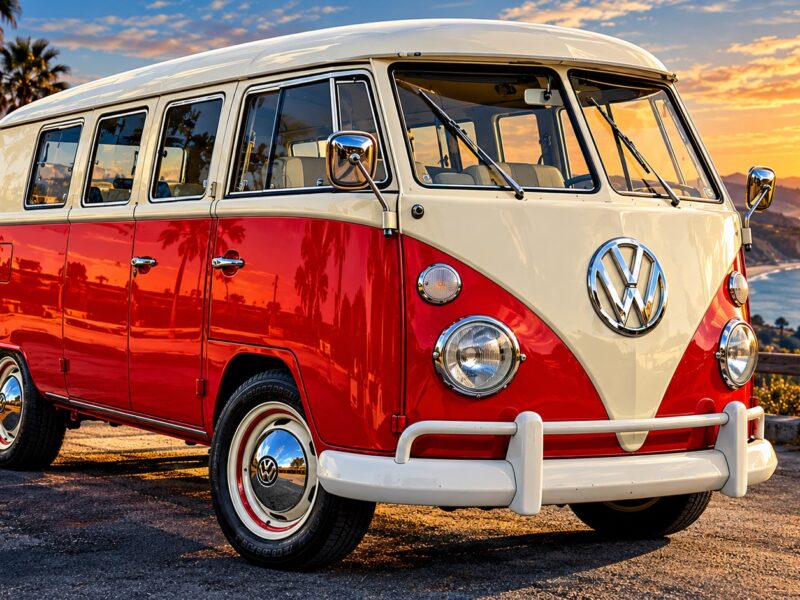


ELEVEN WINDOWS. AN AIR-COOLED ENGINE. SIXTY-THREE YEARS OF HISTORY. AND ONE REALLY COOL DISCOVERY!
A 1963 VOLKSWAGEN SPLIT-WINDOW BUS! A CLASSIC TWO-TONE PAINT JOB! AND SOME OF THESE OLD VWs ARE SELLING FOR $40,000, $50,000, OR MORE!
Well, The Cool Car Guy stumbled across another cool car!
I was walking through a parking lot along a rural road in New Mexico when I spotted something that immediately caught my attention.
A 1963 VOLKSWAGEN TYPE 2 TRANSPORTER!
Better known to most people as an old Volkswagen Bus or Microbus.
And here’s the funny part.
IT HAD A FOR SALE SIGN IN THE WINDOW!
I’ve been around cool cars for a long time, but these old Volkswagens still make me stop and look.
This one had classic red-and-white two-tone paint, an old-fashioned interior, a white front bumper, and that unmistakable split windshield.
I thought it was pretty cool!
So I pulled out my phone and took some photographs.
And then I started wondering something.
WHAT ARE THESE OLD VOLKSWAGEN BUSES WORTH TODAY?
Well, after looking at some recent collector-car auction results, I discovered that certain versions of these little German vans are selling for $40,000, $50,000, AND EVEN MORE!
FOR AN OLD VOLKSWAGEN BUS? LOL!
That’s when I decided this was another cool ride worth writing about.
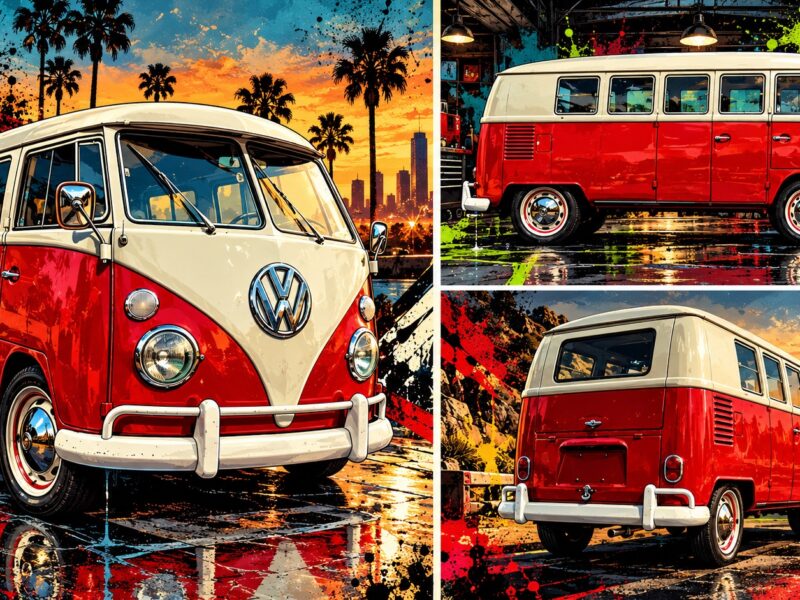
I used the photographs I took as references for some colorful, graffiti-style AI illustrations of this type of VW Bus.
The illustrations aren’t photos of the actual bus, and this isn’t an advertisement offering it for sale.
I JUST THOUGHT IT WOULD MAKE ANOTHER GREAT PARKING SPOT ON COOLCARGUY.COM!
And you might be surprised at what makes these old Volkswagens so desirable to collectors today.
Let’s take a closer look!
🏆 THE LITTLE VOLKSWAGEN BUS THAT BECAME AN AUTOMOTIVE LEGEND!
The Volkswagen Type 2 first arrived in 1950.
The idea was pretty simple.
Take the basic mechanical design of the Volkswagen Beetle, put an engine in the back of a small van, and create something that could carry passengers, tools, camping equipment, groceries, and just about anything else somebody wanted to haul.
It wasn’t designed to be a luxury vehicle. It wasn’t designed to be a sports car.
And it certainly wasn’t designed to compete with a 455-horsepower Chevrolet Camaro!
IT WAS DESIGNED TO GET PEOPLE AND THEIR STUFF FROM ONE PLACE TO ANOTHER!
Somehow, Volkswagen created one of the most recognizable vehicles in automotive history.
Think about it.
When you see an old Split-Window Volkswagen Bus, you immediately know what it is.
You don’t have to look for the badge.
You don’t have to figure out the model year.
IT’S A VOLKSWAGEN BUS!
And for people who grew up in the 1960s and 1970s, these little vehicles bring back plenty of memories.
- Surfboards.
- Camping trips.
- Road trips.
- Woodstock.
- Peace signs.
- And probably a few things people would rather not admit happened in the back of one of these old VWs!
LOL!
But here’s the interesting part.
When these vehicles were new, they were relatively inexpensive, practical transportation.
People used them as family vehicles, delivery vans, work trucks, campers, and just about anything else you could imagine.
Today?
Collectors are paying serious money for some of them!
IT’S AMAZING WHAT SIXTY YEARS CAN DO TO THE VALUE OF AN OLD VEHICLE!
Of course, not every old Volkswagen Bus is worth fifty grand.
But finding a really nice one?
That’s a different story.
🪟 WHAT’S THE BIG DEAL ABOUT A SPLIT-WINDOW VOLKSWAGEN BUS?
Here’s where things get interesting for people who might not know much about these old Volkswagens.
Volkswagen built different generations of the Bus over the years.
The earliest generation is commonly called the T1, and the German-built versions were produced from 1950 through 1967.
These are the famous Split-Window Buses, sometimes called Splitties by enthusiasts.
Why?
Because the windshield is divided into two separate pieces of glass!
Pretty sophisticated technology, huh? LOL!
But that distinctive front end is one of the features that makes these vehicles so recognizable.
Then, for the 1968 model year, Volkswagen introduced the second-generation Bus, known as the T2.
That one came with a larger, single-piece windshield, giving it the nickname Bay-Window Bus.
And here’s why that difference matters.
SPLIT-WINDOW AND BAY-WINDOW VOLKSWAGENS ARE NOT NECESSARILY WORTH THE SAME MONEY!
Collectors often place a considerable premium on the earlier Split-Window models.
Especially when they’re original, well-preserved, or properly restored.
And then there are the different window configurations!
THE ELEVEN-WINDOW VOLKSWAGEN BUS!
The standard eleven-window style is one of the classic early passenger-bus designs.
The window count includes:
- Two sections of the split front windshield.
- Two front-door windows.
- Six rear side windows.
- One rear window.
ELEVEN WINDOWS!
And that doesn’t include any additional pop-out or opening-window arrangements that might have been fitted.
Of course, when you’re dealing with vehicles this old, you want to verify the original factory configuration.
Because somebody might have modified the body or installed different equipment over the years.
But the eleven-window design has a tremendous amount of classic Volkswagen appeal.
AND THEN THERE’S THE FAMOUS SAMBA BUS!
⭐ THE TWENTY-THREE-WINDOW SAMBA — THE VOLKSWAGEN THAT GOT EXPENSIVE!
Now here’s where collectors can get really serious about these old buses.
Volkswagen offered a more elaborate passenger version commonly called the Samba or Deluxe Microbus.
And some of these came with an incredible twenty-three windows!
Why so many? Volkswagen added side and rear-corner windows, along with little skylight windows along the roof.
Some versions also featured a large sliding fabric sunroof.
Imagine riding through the mountains with sunlight streaming through those windows!
Now imagine driving through the desert in 110-degree heat! LOL!
Pretty cool design for the 1950s, although air conditioning might have been nice!
The Samba became one of the most desirable versions of the early Bus.
And here’s a particularly interesting detail about 1963.
1963 WAS A TRANSITION PERIOD FOR THESE CLASSIC VOLKSWAGENS!
As Volkswagen moved into the 1964 model year, it enlarged the rear hatch.
That change eliminated the little rear-corner windows on the deluxe Samba design.
And the famous twenty-three-window Samba became the twenty-one-window version.
That’s why collectors pay attention to production dates and original specifications.
A seemingly small difference in body configuration can make a pretty substantial difference in collector interest.
And those deluxe Samba buses?
SOME HAVE SOLD FOR SIX FIGURES!
Not bad for an old Volkswagen!
But don’t misunderstand me.
You don’t have to buy the most expensive Samba to enjoy one of these classics.
An eleven-window passenger bus, an old Kombi, or even a classic VW camper can be an incredibly cool vehicle.
THERE’S A BUTT FOR EVERY SEAT. EVEN AN OLD VOLKSWAGEN BENCH SEAT! LOL!
💰 WAIT! WHAT ARE THESE OLD VOLKSWAGEN BUSES SELLING FOR TODAY?
About ten years ago, I attended a Mecum Auction in Denver with Becky and a couple of my car-guy pals.
We watched an old Volkswagen Samba Bus go across the auction block for what I thought was a ridiculous amount of money!
I remember being impressed that somebody was willing to spend so much on an old VW Bus.
And that’s one of the reasons I started researching them again after my recent New Mexico discovery.
AND SOME OF THE NUMBERS ARE PRETTY IMPRESSIVE!
Consider these actual 2026 auction results:
| Volkswagen Bus | Auction Sale |
|---|---|
| 1963 Type 2 11-Window, non-running project — February 2026 | $33,750 |
| Modified 1965 Type 2 11-Window — July 2026 | $48,000 |
| Modified 1965 Type 2 11-Window — May 2026 | $58,000 |
THIRTY-THREE THOUSAND, SEVEN HUNDRED AND FIFTY DOLLARS FOR A NON-RUNNING PROJECT!
And that vehicle was a 1963 eleven-window Volkswagen!
Now that’s pretty interesting.
The other examples were modified 1965 models with upgraded engines and equipment.
They weren’t identical vehicles, and the prices aren’t necessarily what another VW Bus would sell for.
But they demonstrate something important.
THERE ARE PEOPLE WILLING TO SPEND SERIOUS MONEY ON THESE OLD VOLKSWAGENS!
And there’s another side to the collector-car market.
A beautifully restored vehicle might bring a substantial premium.
An original survivor with documented history could also attract serious collectors.
But a rusty project with missing parts, questionable body repairs, and a worn-out engine?
That’s a different conversation! Sometimes the purchase price is only the beginning.
AND SOMETIMES THE CHEAPEST CLASSIC CAR BECOMES THE MOST EXPENSIVE ONE IN YOUR GARAGE! LOL!
🔥 HOW MUCH HORSEPOWER DOES A 1963 VOLKSWAGEN BUS HAVE?
Okay, this is pretty funny.
I recently wrote another Parking Spot about the 2016–2018 Chevrolet Camaro SS.
That car has a 455-horsepower V8!
Before that, I wrote about the 2015–2017 Ford Mustang GT, with 435 horsepower!
And now we’re talking about a 1963 Volkswagen Bus.
HOW ABOUT FORTY OR FIFTY HORSEPOWER?
I’m not joking!
Early 1960s Volkswagen buses used small rear-mounted, air-cooled, four-cylinder engines.
For 1963, the engine choices and equipment varied depending on the market and production date.
The smaller 1.2-liter flat-four produced approximately 40 horsepower under period American ratings.
Volkswagen also introduced a larger 1.5-liter engine, rated at approximately 50 horsepower in period specifications.
That larger engine was a pretty meaningful upgrade for something that wasn’t exactly overflowing with horsepower!
And the engines were paired with a four-speed manual transmission.
THAT’S A WHOLE DIFFERENT DRIVING EXPERIENCE FROM A 455-HORSEPOWER CAMARO! LOL!
- No paddle shifters.
- No giant touchscreen.
- No turbocharger.
- No sophisticated computer-controlled suspension.
Just a little air-cooled engine in the back trying to move a Volkswagen Bus down the highway.
And here’s something else.
An old VW Bus doesn’t drive like a modern minivan.
The steering, brakes, handling, acceleration, and overall driving experience are very different.
You’re sitting way up front, with that enormous old-fashioned steering wheel in front of you.
Depending on the configuration, the engine is making a whole lot of noise behind the passengers.
And you’re definitely not setting any quarter-mile records!
BUT THAT’S NOT WHY PEOPLE BUY THESE THINGS!
They buy them because they’re different.
They’re nostalgic.
They have personality.
And they make people smile.
You could park a brand-new luxury SUV next to an old Volkswagen Bus at a car show.
Guess which one might attract more people taking photographs?
THAT OLD VOLKSWAGEN BUS!
Sometimes being cool has absolutely nothing to do with horsepower.
🚐 THE KOMBI, MICROBUS, WESTFALIA, AND OTHER COOL VW VERSIONS!
One of the things that makes the early Volkswagen Type 2 so interesting is how many versions were built.
There wasn’t just one Volkswagen Bus. There were all kinds of them!
THE KOMBI
The Kombi was designed to be a flexible people-and-cargo carrier.
Depending on the equipment, it could transport passengers, goods, or a combination of both.
It’s the kind of simple working vehicle that helped make Volkswagen’s Transporter popular around the world.
THE MICROBUS
The Microbus was the passenger-oriented version that many people remember.
Multiple rows of seats, plenty of windows, and a practical design made it popular with families and businesses.
Of course, today an original interior in good condition can be an important part of a vehicle’s collector appeal.
THE WESTFALIA CAMPER
I’m not much of a camper, but people who are absolutely love these things!
Volkswagen also became famous for camper conversions, especially those associated with Westfalia.
Some featured camping furniture, sleeping arrangements, storage, and equipment intended for traveling.
These became incredibly popular with people who wanted to get out and explore.
Apparently, traveling across the country in a little air-cooled Volkswagen camper has a certain charm.
Although with forty or fifty horsepower, you might want to allow a little extra time getting over the mountains!
LOL!
It’s not exactly my idea of a luxury vacation, but plenty of people love it!
THE PICKUPS AND WORK VANS
Volkswagen also produced panel vans, single-cab pickups, double-cab pickups, and other commercial configurations.
Some of these had clever storage arrangements and were used as everyday work vehicles.
Think about that.
A vehicle that somebody might have used to deliver bread or haul tools sixty years ago could now be sitting in a collector’s garage.
WHO WOULD HAVE THOUGHT THAT AN OLD WORK VAN COULD BECOME A COLLECTOR CAR?
But that’s exactly what happened!
🛠️ THE CARBURETOR, AIR-COOLED ENGINE, AND OTHER OLD VW QUIRKS!
Here’s something to remember when you’re shopping for one of these Volkswagens.
THEY’RE OLD!
It’s easy to get lost in nostalgia, but a sixty-three-year-old VW is a different proposition from a ten-year-old car. Many have spent years sitting in barns, garages, or dusty parking lots.
And sitting can create problems!
THE CARBURETOR AND FUEL SYSTEM
Early Type 2 engines had simple carbureted fuel systems that a knowledgeable VW mechanic can work on. Some replacement parts and rebuild kits are surprisingly affordable.
But here’s what I’d watch for.
IF ONE OF THESE OLD VOLKSWAGENS HAS BEEN SITTING FOR YEARS, THE CARBURETOR MIGHT NOT BE THE ONLY PROBLEM!
Old fuel can leave deposits. Fuel tanks can develop corrosion or contamination. Rubber hoses deteriorate.
And filters can become clogged.
I’VE OWNED A FEW OLD VOLKSWAGENS MYSELF!
I’ve personally owned multiple VWs over the years. And I remember having one with a fuel filter that would periodically clog up.
Here’s the ridiculous part.
I’d pull over, remove the filter, blow it out, reconnect it, and get going again!
LOL!
I guess I thought that was easier than actually replacing the filter!
Looking back, that wasn’t particularly smart, especially considering the potential fire hazards associated with old fuel systems.
But when you’re young, sometimes you do things that make perfect sense at the time.
And years later you wonder what you were thinking!
WHAT ELSE WOULD I CHECK?
If I were shopping for an old VW Bus, I’d check the engine, transmission, brakes, electrical system, steering, suspension, and restoration history. It sounds like a lot, but an old ride might need a complete rebuild!
Early buses commonly used drum brakes and six-volt electrical systems, although many surviving examples have been modified or upgraded.
You can walk into AutoZone and grab a 12-volt battery without much trouble. But ask for a six-volt battery and the eighteen-year-old parts guy driving a Supra might look at you like you just stepped out of Back to the Future! LOL!
I’d also check the heating system, oil leaks, cooling tin, and general engine condition.
Because an air-cooled Volkswagen engine depends on its cooling system being properly assembled and maintained.
What does that mean? Well, it’s something else that’s pretty interesting about these old Volkswagens.
THEY DON’T HAVE A RADIATOR!
That’s right! No radiator, water pump, liquid coolant, or radiator hoses.
Instead, an engine-driven fan forces air over the engine’s cooling fins, while the engine oil and oil cooler help carry away heat.
Pretty simple technology! But here’s the catch.
JUST BECAUSE IT’S AIR-COOLED DOESN’T MEAN YOU CAN IGNORE THE COOLING SYSTEM!
The fan, belt, shroud, and metal cooling tin all need to be in good condition and properly installed.
Because even an air-cooled engine can overheat!
AND COOKING YOUR ENGINE ISN’T THE KIND OF AIR-COOLED EXPERIENCE VOLKSWAGEN HAD IN MIND! LOL!
And then there’s one more important issue.
THE RUST!
In some places, rust is practically a factory option. A little Bondo and undercoating, and somebody calls it fixed! LOL!
But structural rust is another story.
⚠️ THE BIGGEST USED VOLKSWAGEN PROBLEM MIGHT NOT BE THE ENGINE!
Here’s something I’d pay particular attention to when shopping for a Split-Window Volkswagen.
THE BODY!
Mechanical components can often be repaired or replaced.
But major structural rust repairs? Those can become expensive!
On an old Volkswagen Bus, I’d want to inspect the lower body panels, rocker panels, front doglegs, cargo-door bottoms, floors, frame structure, and areas around the battery.
And I’d be particularly suspicious of an old vehicle that looked fantastic on the outside but had no documentation showing what was underneath the paint.
Because sometimes a beautiful restoration really is a beautiful restoration.
And sometimes it’s a whole lot of body filler hiding somebody else’s problems!
THE COOL CAR GUY REALITY: A solid, original body can be much more valuable than a shiny new paint job.
And putting a sixty-three-year-old collector vehicle right can get expensive!
Think of it like getting Grandpa a new set of choppers. That’s not the same dentist bill as a routine cleaning! LOL!
I’d check whether the engine, interior, windows, and trim are original. Some collectors want factory-correct vehicles; others prefer upgraded brakes, engines, or electrical systems.
Of course, you’re still driving an old VW Bus with a giant steering wheel. Nobody’s mistaking it for a modern sports car!
Both approaches can make sense.
THE TRICK IS KNOWING WHAT YOU’RE BUYING!
A modified Volkswagen and a factory-correct original aren’t necessarily worth the same money.
And if you’re not a collector and don’t care about originality? That’s another story altogether.
🔎 HOW DO YOU KNOW IF AN OLD VOLKSWAGEN IS REALLY WHAT THE SELLER SAYS IT IS?
Not every old VW Bus is configured as it left the factory. Some were converted into campers, modified with bigger engines or upgraded brakes, or repaired with replacement body panels.
For collectors who care about originality, that matters.
I’m mostly writing for people who are curious about these old buses. Seasoned collectors probably know what they want already!
Volkswagen used factory identification information that can help establish original equipment. Enthusiasts often check the M-plate for production details and factory options.
Because if somebody tells you they’ve got a rare factory model, I’d want to know whether the vehicle really started life that way.
A FEW EXTRA WINDOWS AND A NICE PAINT JOB DON’T AUTOMATICALLY MAKE SOMETHING A GENUINE FACTORY SAMBA!
LOL!
Of course, not everyone cares about originality. Some buyers just want an old Volkswagen to enjoy.
THERE’S NOTHING WRONG WITH THAT EITHER!
Just make sure the price reflects what you’re actually buying.
💰 WHY ARE THESE OLD VW BUSES GETTING SO HARD TO FIND?
Here’s another interesting problem with shopping for a Volkswagen from the early 1960s.
YOU CAN’T CALL UP THE USED-CAR FACTORY AND ORDER A BRAND-NEW 1963 VOLKSWAGEN BUS!
LOL!
Volkswagen stopped building the original German T1 generation in 1967.
That’s almost sixty years ago!
Volkswagen built plenty of them, but they were working vehicles, used for deliveries, family trips, and hauling just about anything. Many wore out, rusted away, were wrecked or scrapped, or were modified beyond recognition.
THAT MEANS FINDING A REALLY NICE ORIGINAL EXAMPLE CAN BE A CHALLENGE!
And here’s another thing.
Some collectors have owned their old Volkswagens for years and have absolutely no interest in selling them.
They’re part of the family!
Or they’ve spent years restoring one and don’t want to start all over again.
So even if somebody has the money to buy a really nice Split-Window Bus, finding the right one might take time.
THERE’S NO UNLIMITED SUPPLY OF SIXTY-THREE-YEAR-OLD VOLKSWAGENS WAITING TO BE ORDERED!
And that’s part of what makes these old vehicles so desirable. Not necessarily because every one is worth a fortune.
But because a really good one with the right history, condition, and equipment isn’t something you can simply replace tomorrow.
🔍 WAIT! HOW MANY PEOPLE ARE LOOKING FOR OLD VOLKSWAGEN BUSES?
Here’s something else that surprised me.
I asked Google AI how much search interest there is in these old Volkswagen buses.
ITS ESTIMATE? MORE THAN 110,000 SEARCHES A MONTH FOR VW BUS-RELATED SEARCHES!
That’s a whole lot of interest in an old Volkswagen!
Now, most people recognize these vehicles by names like Volkswagen Bus, VW Microbus, or simply an old VW van.
But serious Volkswagen enthusiasts know there’s a BIG difference between the various generations, body styles, and window configurations.
And a 1963 Split-Window Volkswagen can be a particularly interesting vehicle to people who know what they’re looking at.
Of course, those estimated searches don’t mean 110,000 people are trying to buy a specific 1963 Volkswagen every month.
- Some people are researching them.
- Some are looking for restoration parts.
- Some are reminiscing about vehicles they owned years ago.
And some might just enjoy looking at pictures of these old classics!
BUT HERE’S WHAT GETS MY ATTENTION!
There is clearly substantial interest in the iconic Volkswagen Bus.
And I just happened to walk past one sitting in a New Mexico parking lot!
THAT’S WHAT I CALL FINDING ANOTHER COOL CAR TO WRITE ABOUT! LOL!
🌴 WHAT’S THE DIFFERENCE BETWEEN A FOR SALE SIGN AND A PARKING SPOT ON THE INTERNET?
Now here’s something else I started thinking about after my little Volkswagen discovery.
The ’63 VW I spotted had a FOR SALE sign in the window.
Nothing wrong with that! People have been selling cars that way for decades.
But here’s an interesting question.
HOW MANY PEOPLE WHO LOVE SIXTY-THREE-YEAR-OLD VOLKSWAGEN BUSES ARE GOING TO WALK THROUGH THAT PARTICULAR PARKING LOT?
Maybe a few.
Maybe somebody who’s been looking for one will happen to drive past.
But it’s certainly a pretty limited audience compared with the number of people who can discover an interesting automotive story online.
And that’s one of the reasons I redesigned CoolCarGuy.com into a place where people can share and promote cool-car stories.
I CAN TAKE AN INTERESTING CAR STORY AND GIVE IT A PARKING SPOT ON THE INTERNET!
Instead of relying entirely on people walking past a vehicle, I can publish an entertaining story about a cool car, give it its own URL, and share it with people on Facebook, LinkedIn, X, and other websites.
And that article can potentially be discovered through Google and other search services long after the original social media posts are buried.
Of course, publishing an article here doesn’t guarantee everyone will find it.
But at least you’ve created something that can continue reaching people over time.
AND HERE’S THE REALLY COOL PART!
I don’t have to own the Volkswagen I saw to write about the history, design, and collector appeal of these old buses.
I’m not offering that particular vehicle for sale. It simply inspired me to write about one of the most recognizable classics ever built!
And I used AI to help create the illustrations you see in this Parking Spot.
THE VEHICLE INSPIRED THE STORY. THE STORY BECAME A PARKING SPOT.
That’s what I think makes this whole concept pretty interesting.
And if you own a cool car or have a story worth sharing, you can give it a Parking Spot, too!
⭐ WOULD I BUY A 1963 VOLKSWAGEN SPLIT-WINDOW BUS?
MAYBE!
Because like every other cool car I’ve written about, it would depend on the vehicle and the numbers.
Some people want a completely restored bus they can take to car shows. Others prefer an original survivor with some patina and history.
And some people actually enjoy restoring these old vehicles!
They want something they can work on every weekend.
HECK, SOME OF THOSE PEOPLE WOULD PROBABLY RATHER WORK ON THE VOLKSWAGEN THAN DRIVE IT!
Personally, I’d be particularly interested in a solid body, good documentation, and a realistic purchase price.
Because buying a cool classic car is one thing.
BUYING IT AT A PRICE THAT MAKES SENSE IS ANOTHER!
And sometimes the best collector car is simply the one you really enjoy owning.
Not the one somebody tells you is going to double in value.
I’D BUY A COOL VOLKSWAGEN BECAUSE I WANTED A COOL VOLKSWAGEN!
If it holds its value, that’s great. If it appreciates, even better.
But I’d much rather own something that puts a smile on my face than something sitting in the garage that I’m afraid to drive!
🚐 WANT A CLASSIC VOLKSWAGEN BUS? MAYBE I CAN HELP YOU FIND ONE!
Now, if reading this story has you thinking about owning one of these classic Volkswagen buses, maybe I can help!
I’ve been buying and selling vehicles for more than twenty years, and I have access to vehicle sources and relationships that aren’t available to the general public.
Maybe you’re looking for a 1963 Split-Window Bus.
Maybe you want an eleven-window passenger version, a camper, or even a restoration project.
Or perhaps there’s another classic car you’ve been searching for!
TELL ME WHAT YOU’RE LOOKING FOR!
Here’s what would help:
- The model and years you’re interested in.
- Whether you want an original survivor, restored vehicle, or project.
- Your preferred colors and equipment.
- Your location and when you’re looking to buy.
- Whether you’re paying cash, financing, or have a trade.
- MOST IMPORTANTLY, WHAT YOU’RE WILLING TO PAY FOR THE RIGHT VEHICLE!
And don’t make this complicated. I’m not asking you to fill out an eleven-page questionnaire just because we’re talking about an eleven-window VW! LOL!
Just send me a message, call, text, or email me with some basic information.
I can’t promise I’ll find exactly what you’re looking for, but I’m happy to see whether there’s a vehicle available through my sources and relationships that makes sense for you.
I don’t charge a separate fee for my vehicle-sourcing services. I’m compensated through a completed transaction when the numbers work.
THE NUMBERS EITHER WORK OR THEY DON’T!
And if the right buyer and the right cool car come together?
THAT’S WHEN THINGS GET FUN!
🌴 GOT A COOL CAR STORY OF YOUR OWN? WHY NOT CREATE A PARKING SPOT?
Here’s something else worth mentioning.
Maybe YOU own an old VW Bus, a classic, or some other cool ride.
Maybe you’re restoring one, thinking about selling a vehicle you own, or just enjoy sharing cool-car stories.
Or perhaps you want to show off your ride and tell its story!
DID YOU KNOW YOU CAN CREATE A PARKING SPOT ON COOLCARGUY.COM FOR JUST $7?
SEVEN BUCKS.
I kept it cheap on purpose so anybody can participate.
Add your own photographs, videos, stories, and opinions.
You can even use AI-generated illustrations like I did for this Parking Spot, as long as you clearly identify them as illustrations rather than real photographs.
Give your Parking Spot a dedicated URL and share it on Facebook, X, LinkedIn, or wherever you want.
And if you’re selling a cool car you own or are properly authorized to sell, you can create your own advertisement and communicate directly with interested buyers.
YOU DON’T NEED TO HIRE ME TO SELL YOUR CAR!
That’s another reason I built CoolCarGuy.com.
STOP AT ONE LISTING OR BUILD A GARAGE AND A CHANNEL!
And here’s something else.
You can join the free Cool Car Guy affiliate program and start earning commissions by introducing other people to CoolCarGuy.com.
You don’t have to own a cool ride to become an affiliate!
You can simply help other people discover a website where they can create their own Parking Spots.
You could even build a business promoting cool cars!
Because here’s something I’ve learned about advertising over the years.
YOU NEVER KNOW WHO MIGHT BE INTERESTED IN THE COOL CAR SITTING IN YOUR GARAGE!
But first, they’ve got to find out about it.
And that’s what advertising is supposed to accomplish!
CREATE YOUR OWN $7 PARKING SPOT!
Thanks for visiting!
— The Cool Car Guy™
ABOUT THIS PARKING SPOT: This is an editorial article inspired by a vintage Volkswagen I happened to spot in New Mexico. I do not own or represent the seller of that specific vehicle, and it is not being offered for sale through this Parking Spot. The auction results are historical examples provided for general collector-car information, not an appraisal of the vehicle I discovered.
IMAGES NOTE: The Volkswagen images used for this Parking Spot are AI-generated illustrations created for editorial storytelling purposes. They are not photographs of the specific vehicle I discovered or of any vehicle currently offered for sale.