
Why Modern Classic Cars Are Harder to Restore Than Ever
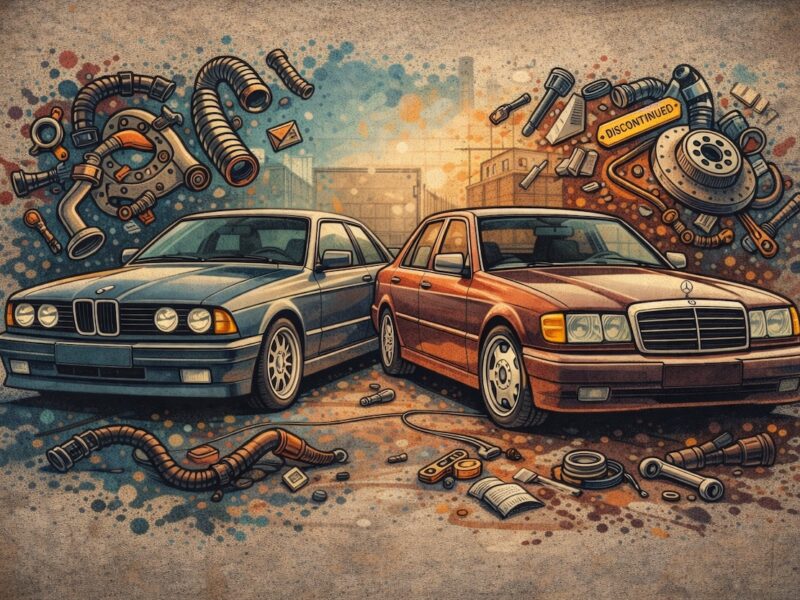

The Cool Car Guy’s Perspective on Parts, Liability, and the Cars That Get Parked Instead of Finished
I was at a well-known German Motorwerke shop in Albuquerque recently, waiting on a repair for my 2015 BMW M235xi.
Nothing exotic — just a solenoid related to the exhaust that needed to be replaced.
While I was there, I mentioned to the owner that I was brokering cars again and asked a simple question:
“Do you have anyone looking to buy, sell, or trade something interesting?
If they just want to move something, I can get it to the dealer auction here as well.”
He smiled and said:
“Interesting. All the time, actually. I get calls from out of state too. And I turn most of them away.”
That caught my attention.
The storage area was full of the usual suspects — older BMWs, Mercedes sedans, a few Porsches, even a Karmann Ghia.
Cars that enthusiasts love.
Cars people want to save.
It looks more like a used car lot than a repair shop.
So I asked why.
I figured I’d get the honest take from someone who’s been fixing German cars for a very long time.
The Problem Isn’t Labor Anymore
It’s Parts — and Everything Attached to Them
His answer was simple:
“The problem isn’t necessarily the work. It’s the parts.”
Fix one thing, something else fails.
Track down a replacement and find out it’s discontinued, backordered indefinitely, or priced like it’s made of gold.
What used to be a restoration project has become a scavenger hunt across:
-
OEM suppliers
-
aftermarket manufacturers
-
eBay listings
-
obscure forums
-
international sellers
-
donor cars that may or may not be complete
Many shops simply don’t want to deal with it anymore.
And honestly — I can’t blame them.
At first glance, this feels like a classic “find a need and fill it” opportunity.
But when you step back from that narrative, the reality looks very different.
There Aren’t Many Places to Send These Cars Now
I laughed and said:
“Unless someone wants a low rider or classic upholstery with good body work, there really aren’t many restoration shops around here — especially for German cars.”
He nodded.
Years ago, the previous owner of the shop specialized in Porsches. Parts were more available back then, and even then much of the work still had to be sent out.
Today, it’s an entirely different story.
Modern classics — especially German cars from the 1980s through early 2000s — live in an uncomfortable middle ground:
-
Too new to be fully “classic”
-
Too old to be fully supported
-
Too complex to be simple
-
Too valuable to throw away
That’s just the starting list.
Why Doesn’t Someone Just Make the Parts?
This is where most people stop thinking — and where reality starts.
On paper, the solution sounds obvious:
“Just 3D print the parts.”
Not so fast.
-
They’re not OEM
-
Material tolerances may differ
-
Heat, vibration, and stress testing matter
-
One failure can cause a chain reaction
-
Liability is massive if something goes wrong
You’re not printing cup holders.
You’re recreating engineered systems.
“Just reproduce them aftermarket.”
Body shops already fight this battle.
A friend I went to high school with has done body work his entire career. When I was selling cars in Denver, he used to tell me about cheap overseas replacement parts that didn’t match OEM specs because insurance companies were cutting costs.
He’d be bending panels, reworking edges, elongating holes — just to make them fit.
Now imagine doing that on a classic German car…
owned by someone with money.
Money usually comes with expectations.
“Close enough” isn’t close enough.
The profit you thought you’d make turns into a masterclass in customer service — and avoiding bad Google reviews.
Compare that to replacing a solenoid on a 2015 BMW, collecting your $300, and moving on to the next car.
“Just Machine Them Overseas”
Still not a free pass.
-
Tooling costs are high
-
Quality control must be perfect
-
Shipping delays kill timelines
-
Specs drift
-
Liability doesn’t disappear because production is offshore
And then you hit the wall every smart business eventually hits.
The Liability Wall
Where Most “Great Ideas” Die
Brakes.
Steering.
Suspension.
Airbags.
Seat sensors.
I used to know a guy in Denver who was excellent at repairing airbag seat sensors. He knew exactly what he was doing.
But here’s the truth most people don’t want to say out loud:
👉 Just getting the airbag light to turn off doesn’t mean the airbag will work when you actually need it.
Who wants to sign their name to that risk — at scale?
One failure.
One accident.
One lawsuit.
That’s how these businesses end — quickly.
The Data Behind the Problem
There are over 300 million vehicles on the road in the U.S.
If you’ve spent time on CoolCarGuy.com, you already know that 44 million+ of those fall into enthusiast categories.
Even if just 1% land in the “aging enthusiast / hard-to-source parts” zone, that’s 3 million vehicles.
German cars from the 80s, 90s, and early 2000s are especially vulnerable.
BMW (80s–early 2000s)
-
Cooling systems fail predictably
-
Suspension bushings and ball joints wear
-
Window regulators and seat sensors fail
-
Instrument clusters and restraint systems act up
Mercedes-Benz (80s–early 2000s)
-
Suspension components loosen with age
-
Electronics fail — windows, seats, clusters
-
Rust appears in known areas
-
Cooling and timing components age out
-
Interior trim becomes brittle and unobtainable
And that’s before we even touch Porsche, Volvo, Jaguar, or true exotics.
None of this makes the cars bad.
It makes them harder to keep alive.
The Facebook Marketplace Trap
This is where people get fooled.
You see a “great deal” online and think:
“I’ll just restore it.”
Until you realize:
-
the part you need is discontinued
-
the aftermarket option doesn’t fit
-
the used part costs more than the car
-
the shop won’t take the job
-
the car runs… until the next failure
That’s how projects stall.
It’s also why you see people collecting cars instead of restoring them — and why many of those cars quietly sit once one critical component fails.
Not because owners don’t care.
Because the system makes it exhausting.
The Real Insight Most People Miss
These cars aren’t disappearing because no one loves them.
They’re disappearing because the risk-reward math no longer works.
If you’re a shop owner, this explains why certain jobs no longer make sense.
If you’re an enthusiast, this explains why projects stall.
If you’re a buyer, this explains why “cheap” cars aren’t cheap.
And if you’re a seller, this explains why timing matters more than perfection.
Cars don’t get sold because they’re bad.
They get sold because owners get tired.
That moment — when time, parts, patience, and reality collide — is when stories turn into transactions.
That’s also where deals are born.
This isn’t a mass-market opportunity.
It’s a selective one — for people with patience, expertise, and a tolerance for complexity.
If You’re Sitting on One of These Cars…
If you’ve got:
• a BMW, Mercedes, Porsche, or classic parked
• a project you meant to finish
• a car that’s too good to scrap
• or a story that explains why it’s sitting instead of driven
This is the place to tell it.
Not because every car needs saving —
but because every car reaches a moment where the next move matters more than a perfect outcome.
This isn’t a place to hand someone your problem.
It’s a place to put your car — and your story — into the open and let the market respond.
When someone is willing to place the listing, tell the truth, and see how it lands, clarity usually follows.
That’s the point.
The listing does the talking first.
If a deal needs structure after that, I can step in — I broker vehicles regularly and have options that don’t exist in typical consumer channels.
That matters because, as this story shows, many shops and dealers simply won’t touch situations like these. It’s not that the cars are bad — they just fall outside how most of the industry is set up to operate.
Sometimes the smartest move isn’t fixing everything.
Sometimes it’s knowing when the story needs a new chapter.
Why This Story Lives on CoolCarGuy.com
CoolCarGuy isn’t about pretending every project gets finished.
It’s about telling the truth behind cool cars:
• why a build stalled
• why a car got parked
• why patience ran out
• and why the timing suddenly makes sense
A stalled restoration is still a cool car.
It just hasn’t met the right moment — or the right person — yet.
Want to Park a Car or Story Like This?
CoolCarGuy.com exists for cars that deserve more than a rushed classified ad and a reset clock.
You don’t need a perfect build.
You don’t need a dealership.
You don’t need to rush.
You need an honest story — and a place that lets it breathe.
A full-page Parking Spot on CoolCarGuy.com costs $7 one time.
Maybe you have a stalled project.
Maybe the parts are getting impossible to find.
Maybe you’re finally ready to sell it.
Or maybe you just have a cool car story worth putting somewhere permanent.
Build the Parking Spot. Tell the story. Grab the URL. Start sharing it.
If a situation calls for it, I also help place and structure deals around interesting vehicles — from enthusiast cars to practical everyday needs.
👉 CREATE A $7 PARKING SPOT
👉 Or reach out if you want help placing the right car with the right next owner.
This is where cool cars stop sitting — and start finding their next chapter.
— The Cool Car Guy